



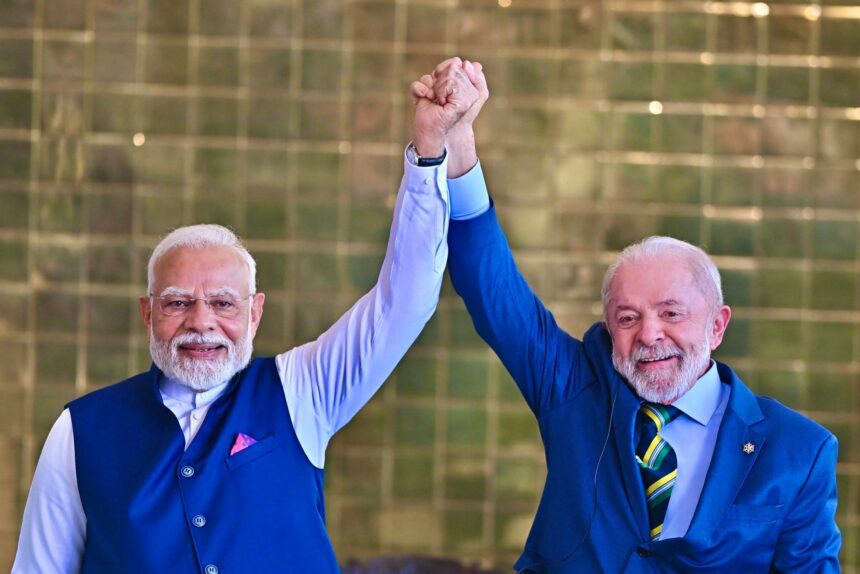
Prime Minister Narendra Modi has congratulated Luiz Inácio Lula da Silva on his re-election as President of Brazil, describing him as a “dear friend” and expressing confidence in taking the India–Brazil Strategic Partnership to a deeper and broader level.
Lula was re-elected in Brazil’s presidential runoff on October 25, defeating right-wing Senator Flávio Bolsonaro. Brazil’s Superior Electoral Court (TSE) announced that Lula secured 51.79% of the valid votes, compared with 48.21% for Bolsonaro, giving Lula a fourth, non-consecutive term as president.
Modi congratulates Lula
Following the result, Prime Minister Modi posted his congratulations, saying he looked forward to working closely with Lula to further deepen and expand the multifaceted India–Brazil Strategic Partnership.
Modi also highlighted the importance of cooperation between the two countries across diverse sectors and stressed their shared priorities as major countries of the Global South. He said the two nations would continue working towards a more inclusive, equitable and sustainable world.
The message is significant because it comes at a time when India and Brazil are seeking to give greater strategic depth to their relationship, particularly on trade, technology, energy, defence, agriculture and multilateral diplomacy.
A relationship that has grown beyond trade
India and Brazil have maintained diplomatic relations for decades, with their partnership elevated to the level of a Strategic Partnership in 2006. The relationship has since expanded into areas including trade and investment, defence, agriculture, pharmaceuticals, energy, space, science and technology and digital cooperation.
During Prime Minister Modi’s state visit to Brazil in July 2025, the two leaders discussed an ambitious roadmap for expanding bilateral cooperation. They agreed to work towards increasing bilateral trade to US$20 billion over the following five years and identified areas such as clean energy, artificial intelligence, semiconductors, space, digital public infrastructure, agriculture and defence for greater collaboration.
The two sides also signed agreements covering areas including counter-terrorism and transnational organised crime, renewable energy, agricultural research, digital transformation and the protection of classified information.
Trade ties gaining momentum
Economic relations have also been expanding. According to India’s Ministry of External Affairs, India–Brazil bilateral trade reached US$15.21 billion in 2025, up from US$12.20 billion in 2024 — an increase of more than 25%. India’s exports to Brazil stood at US$8.35 billion, while imports from Brazil amounted to US$6.85 billion.
The two countries are therefore looking beyond traditional commodities and seeking greater cooperation in technology, pharmaceuticals, energy, agriculture, digital infrastructure and other emerging sectors.
Why the Global South matters
Perhaps the most important element of Modi’s message is his reference to the Global South.
Both India and Brazil have increasingly positioned themselves as important voices representing developing and emerging economies in international institutions. Their cooperation has extended through platforms such as BRICS, IBSA and the G20, where both countries have advocated reforms to global governance and greater representation for developing nations.
India and Brazil have also supported reform of the United Nations Security Council, including greater representation for developing countries. Brazil has backed India’s candidature for a non-permanent Security Council seat for the 2028–29 term.
The two countries’ coordination could therefore become increasingly relevant as emerging economies seek a stronger voice on issues such as climate change, development finance, technology, food and energy security, international trade and reform of global institutions.
What Lula’s new term could mean for India
Lula’s re-election provides continuity to a relationship that has strengthened considerably during his current term. Modi and Lula have developed a close personal diplomatic rapport, with the Indian Prime Minister referring to Lula as a “dear friend.” During Modi’s 2025 visit to Brazil, he described Lula as a key architect of the India–Brazil Strategic Partnership.
The next phase of the relationship is likely to focus on converting political goodwill into concrete economic and technological cooperation. The two governments have already identified areas such as trade, defence, clean energy, AI, space, agriculture, pharmaceuticals and digital public infrastructure as important areas for collaboration.
For India, a stable relationship with Brazil also provides an important partnership in Latin America. For Brazil, stronger engagement with India offers access to one of the world’s fastest-growing major economies and a significant partner in the wider Global South.
A partnership with wider ambitions
Lula’s re-election is therefore more than a change in Brazil’s domestic political landscape. For India, it represents an opportunity to further consolidate a strategic relationship with a major Latin American power.
Modi’s congratulatory message makes that intention clear: India wants the next chapter of its relationship with Brazil to be broader, deeper and more strategically consequential — not only bilaterally, but also in shaping the voice of the Global South.