



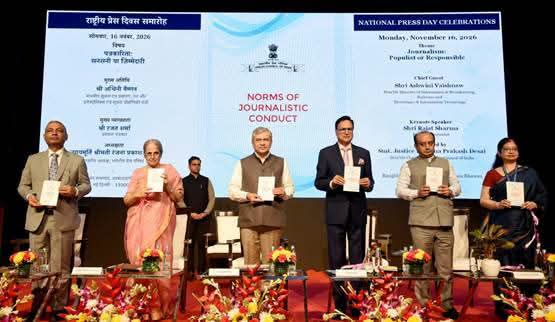
New Delhi, November 16: The importance of maintaining journalistic integrity while adapting to the rapidly changing media and technological landscape was at the centre of discussions during the National Press Day celebrations organised by the Press Council of India in New Delhi on Monday.
Union Minister for Information and Broadcasting Ashwini Vaishnaw, addressing the gathering at Rangbhawan Auditorium, Akashvani Bhawan, stressed that freedom of expression must go hand in hand with responsibility. He highlighted the media’s important role in strengthening democratic institutions and keeping citizens informed.
Pointing to the speed of technological transformation, Vaishnaw observed that the coming five years could bring changes greater than those witnessed over the previous two decades. He encouraged journalists, particularly younger professionals, to embrace new technologies and continuously upgrade their skills.
The minister also drew attention to growing challenges in the digital information ecosystem, including misinformation, deepfakes, misleading advertisements and harmful online content. He stressed the need for greater accountability among digital platforms to protect citizens and address emerging concerns.
Press Council of India Chairperson Justice (Retd.) Ranjana Prakash Desai reaffirmed the importance of protecting press freedom while maintaining high standards of professional journalism. She pointed out that the widespread availability of smartphones and internet access has made information dissemination easier than ever, but the ability to publish information does not automatically ensure adherence to journalistic ethics.
Secretary of the Ministry of Information and Broadcasting Chanchal Kumar highlighted the need to protect the credibility of journalism in an increasingly competitive digital environment. He stressed that audience engagement, popularity and online visibility should never come at the cost of factual accuracy.
Addressing the growing use of Artificial Intelligence (AI) in media, Kumar underlined that the technology can support journalistic work, but the responsibility for editorial decisions, verification and accountability must remain with human professionals.
Veteran journalist Rajat Sharma, who delivered the keynote address, also cautioned against sensationalism and emphasised the importance of accuracy, restraint and responsible reporting, particularly when covering sensitive national issues.
This year’s National Press Day theme, ‘Journalism: Populist or Responsible’, highlighted the growing need to distinguish between journalism driven by popularity and reporting guided by facts, public interest and professional ethics.
A major highlight of the programme was the release of the 2026 edition of the Norms of Journalistic Conduct by the Press Council of India. The updated guidelines address several important areas, including reporting during natural disasters and conflicts, coverage of protests, reporting involving sex workers and persons with disabilities, protection of children’s privacy and advertisements related to online money games.
The celebrations also witnessed the participation of PCI Member and Rajya Sabha MP Dr Sudhanshu Trivedi, along with other dignitaries and media professionals.
The discussions served as a reminder that technological advancement and the growing reach of digital media must be accompanied by accuracy, fairness and accountability. As the media environment continues to evolve, maintaining public trust remains one of journalism’s most important responsibilities.