

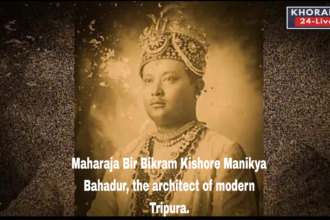



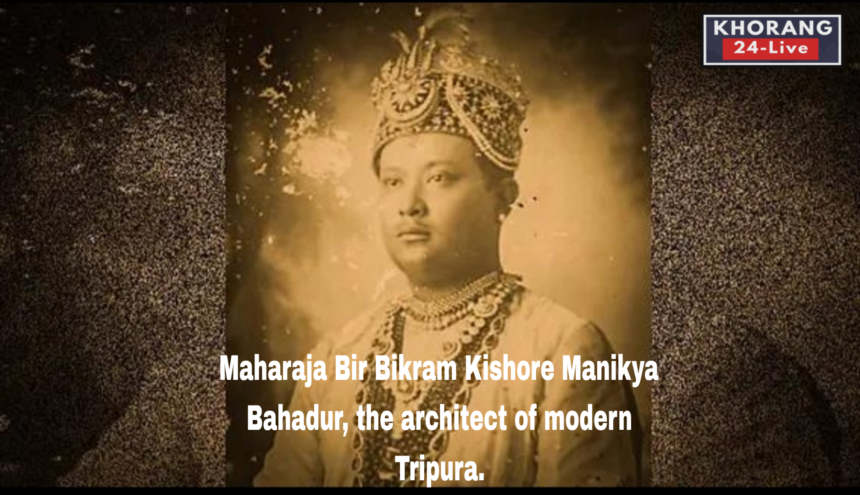
August 19, 2026: On the birth anniversary of Maharaja Bir Bikram Kishore Manikya Bahadur, Tripura once again remembers a ruler whose ideas helped lay the foundations of the modern state.Born on August 19, 1908, Maharaja Bir Bikram ascended the throne of Tripura in 1923 and remained its ruler until his death on May 17, 1947. He is widely remembered as the “Architect of Modern Tripura” for his emphasis on education, infrastructure, administration, urban development and the welfare of the people.
What makes his legacy remarkable is not simply the number of institutions associated with his name, but the forward-looking nature of his vision. At a time when Tripura was a princely state and modern infrastructure was still limited, Maharaja Bir Bikram sought to build institutions that could serve generations to come.
A VISION FOR EDUCATION
Education occupied a central place in his development strategy. In 1937, he launched the ambitious Vidyapattan Scheme, envisioning an “Abode of Learning” at College Tilla in Agartala.
The plan went far beyond establishing a single college. It envisaged educational and technical institutions along with facilities for physical education, music, painting, healthcare, hostels and other forms of learning. Around 234 acres were earmarked for the project.
Although the Second World War disrupted the original plan, its educational legacy eventually took concrete shape. Maharaja Bir Bikram College, which began functioning in 1947, became Tripura’s first degree college. Today, institutions including Maharaja Bir Bikram University carry forward the memory of that educational vision.
BUILDING CONNECTIVITY FOR THE FUTURE
Maharaja Bir Bikram also understood that development required connectivity.
One of his most enduring contributions was the development of an aerodrome at Agartala. The airport was constructed in 1942 on land donated by the Maharaja. Decades later, the airport was officially renamed Maharaja Bir Bikram Manikya Kishore Airport, recognising his contribution to Tripura’s connectivity and development.
The decision to build an airport in the 1940s reflected a remarkable understanding of the importance of transportation and communication to the future of a geographically isolated region.
A RULER WITH A MODERN ADMINISTRATIVE OUTLOOK
His vision was not limited to buildings and infrastructure. Historical records of Tripura describe administrative reforms during his reign, including the establishment of representative and advisory institutions, reforms in judicial administration, a council of ministers and a legislative assembly.These initiatives reflected an attempt to introduce more structured and modern systems of governance while responding to the changing aspirations of the people.
HIS LEGACY AND THE IDEA OF MODERN TRIPURA
Maharaja Bir Bikram’s legacy can be seen today not only in monuments and institutions bearing his name, but also in the broader development trajectory of Tripura.
Maharaja Bir Bikram University describes him as a visionary who contributed significantly to education, architecture, land reforms, infrastructure and the welfare of indigenous people.
His approach offers an important lesson for the present: true development begins with the ability to imagine what does not yet exist.
The Tripura of his time was vastly different from the Tripura of today. Yet many of the ideas he pursued—better education, improved connectivity, modern administration and institutional development—remain central to the state’s aspirations.
REMEMBERING A VISIONARY
More than seven decades after his passing, Maharaja Bir Bikram Kishore Manikya Bahadur remains an important figure in Tripura’s history.
His greatest legacy may not be any single building, road or institution. It is the idea that a leader must think beyond the immediate needs of his generation and create foundations for those who will come after.
On his birth anniversary, Tripura remembers Maharaja Bir Bikram not merely as the last reigning Maharaja of the princely state, but as a visionary who looked toward a modern, educated and connected Tripura long before that vision became a reality.
His life reminds us that a visionary ruler is remembered not by the power he possessed, but by the future he helped build.Maharaja Bir Bikram Kishore Manikya Bahadur — a name etched permanently in the story of modern Tripura.