




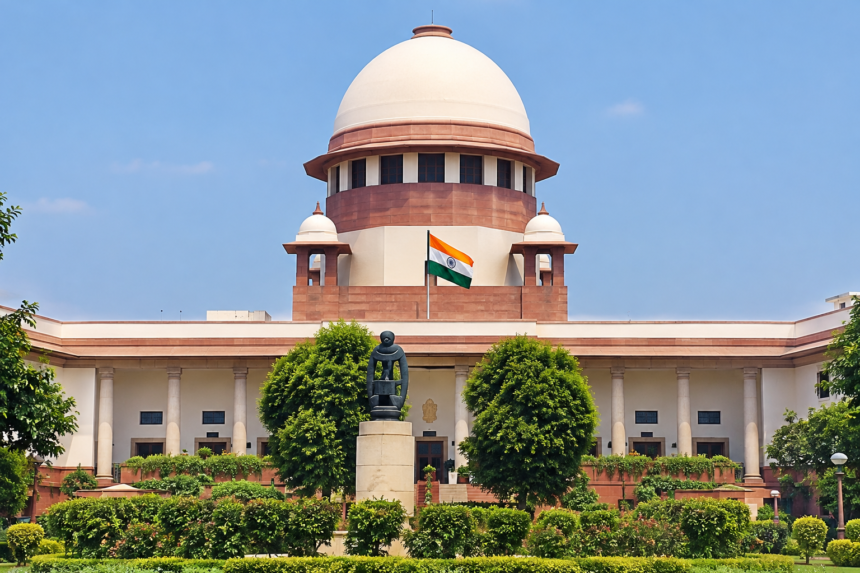
New Delhi: The Supreme Court has sought responses from the Tripura government and the Tripura Tribal Areas Autonomous District Council (TTAADC) on a Public Interest Litigation (PIL) challenging a provision of the Jamatia Customary Laws Act, 2017.
The petition specifically challenges Section 143 of the Act, which deals with punishment for the alleged enticement and rape of a woman under the customary law framework.
The petitioner has questioned the constitutional validity of the provision, particularly its provision for punishment through the customary system. The PIL argues that offences such as rape are serious criminal offences and raises questions about the extent to which customary law can govern such matters.
The matter was heard by a Supreme Court bench comprising Chief Justice of India Surya Kant and Justices Joymalya Bagchi and V. Mohana. The Court sought responses from the concerned authorities and directed that the petition be tagged with an already pending matter.
The petition has been filed by Advocate Madhumita Bhattacharya, through advocate Shoumendu Mukherji. The petitioner has sought a declaration that the challenged provision is unconstitutional and should be struck down.
The case raises important questions concerning the relationship between customary law, tribal autonomy under the Sixth Schedule of the Constitution, fundamental rights and India’s criminal justice system.
The Jamatia Customary Laws Act, 2017 was framed to codify customary practices and institutions of the Jamatia community within the jurisdiction of the TTAADC. The present challenge, however, is directed specifically at the provision concerning enticement and rape and does not, at this stage, amount to a challenge to customary law as a whole.
The Supreme Court has not yet ruled on the constitutional validity of Section 143. The proceedings are presently at the stage where responses have been sought from the Tripura government and TTAADC.
The case could have wider implications for the functioning of customary legal mechanisms in Sixth Schedule areas if the Supreme Court ultimately examines the constitutional limits of such provisions in cases involving serious criminal offences.