

Tripura Returnee Groups Block Road and Rail Routes, Seek Implementation of Peace Accord and Rehabilitation Commitments
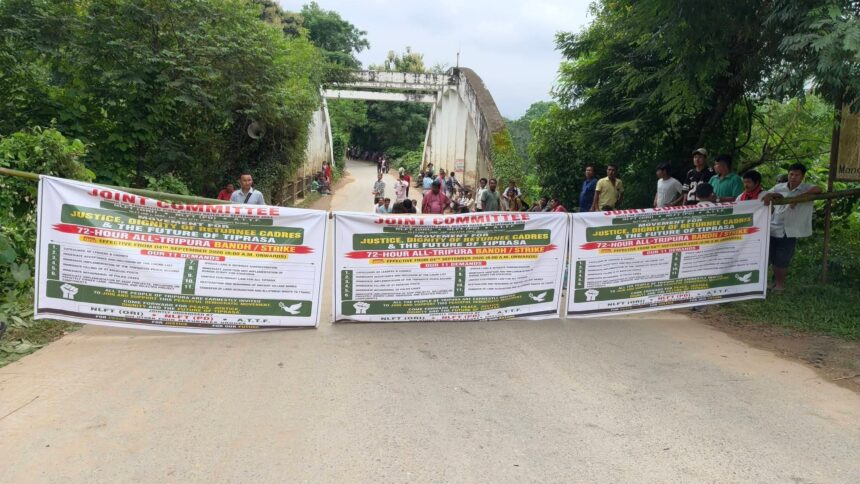
Agartala, September 4, 2026: Road and railway movement has been disrupted at several locations in Tripura, including Hathai Kotor in the Baramura hills, as organisations representing surrendered cadres launched a 72-hour statewide agitation demanding action on their long-pending demands.
The current movement is backed not only by former members of the NLFT and ATTF, but by a wider group of surrendered-cadre organisations and representatives, including the Joint Action Rehabilitation Committee (JARC) and Joint Action Committee (JAC). Reports indicate that seven groups and formations have joined or supported the programme.
The groups had inspected several strategic locations ahead of the September 4 programme, identifying points including Hathai Kotor NH-8, Birgudas railway routes and Khowai Chowmuhani for the agitation.
Why are the groups protesting?
At the centre of the agitation are demands concerning the rehabilitation of surrendered cadres and implementation of commitments made during the peace process.
The groups have alleged that several commitments made after their surrender remain unresolved despite repeated discussions with government authorities.
Among their principal demands are:
Time-bound implementation of the September 4, 2024 Tripartite Peace Accord
Proper rehabilitation of surrendered cadres
Acceptance and inclusion of the list of surrendered cadres
Issuance of identity cards to eligible returnees
Withdrawal of pending police cases against eligible surrendered cadres
Filling of pending Scheduled Tribe backlog vacancies
Implementation of SEDP-related projects
Protection of Tiprasa land and indigenous interests
Adoption and implementation of Roman script for Kokborok
A unified customary law for Tiprasa
Restoration and renaming of ancient village names
Greater powers for the TTAADC over land acquisition and allotment.
JARC-JAC also part of the wider movement
The involvement of JARC and JAC is significant because the two organisations had already undertaken a separate rail and highway blockade at Hathai Kotor in June 2026.
At that time, the organisations raised a nine-point charter of demands, including rehabilitation of surrendered militants and withdrawal of criminal cases. The blockade was withdrawn after the organisations said they received assurances from the state Home Department.
The latest agitation indicates that dissatisfaction among different groups representing surrendered cadres has continued despite earlier assurances and discussions.
Dispute over implementation
The protesting groups have alleged that sufficient progress has not been made on commitments arising from the peace and rehabilitation process.
They have also raised concerns over the implementation of economic-development and rehabilitation programmes, including SEDP, arguing that the economic component is important for the long-term rehabilitation of returnees and indigenous communities.
The groups have appealed to people across Tripura, particularly indigenous communities, to support the 72-hour programme and have described the movement as a peaceful democratic agitation.
Government under pressure to resolve the issue
The latest blockade puts renewed pressure on the Tripura government to address the grievances of surrendered cadres.
The issue has already triggered multiple rounds of protests this year. In June, another blockade affecting road and railway connectivity was withdrawn following government intervention and assurances.
With JARC, JAC and several former militant-group formations now associated with the latest agitation, the movement has assumed a broader character than a protest involving only NLFT and ATTF returnees.
The groups have indicated that stronger forms of agitation could follow if their demands remain unresolved.