





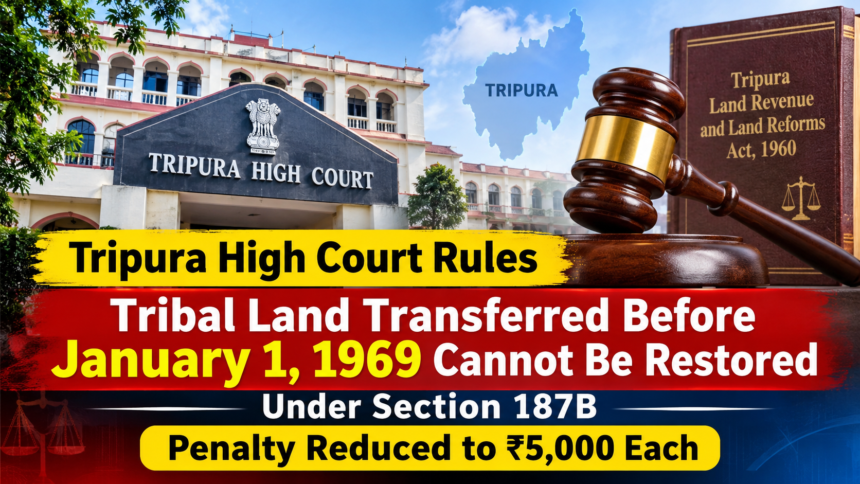
Division Bench says Revenue Officers have no power to restore tribal land transferred or occupied before January 1, 1969; earlier Gauhati High Court judgments declared per incuriam
AGARTALA, November 20: In a significant judgment concerning tribal land rights and long-standing land disputes in Tripura, the High Court of Tripura has ruled that land belonging to Scheduled Tribe communities, if transferred to non-tribals or occupied by them without lawful authority before January 1, 1969, cannot be restored through the special mechanism provided under Section 187B of the Tripura Land Revenue and Land Reforms Act, 1960.
The ruling clarifies the extent of the powers available to designated Revenue Officers in proceedings involving the restoration of tribal land. The Court held that the statutory expression “On or after the 1st January, 1969” appearing at the beginning of Section 187B(1) applies to both categories of cases: transfers of tribal land to non-tribals in violation of the law and unauthorised occupation of land belonging to members of Scheduled Tribe communities.
The judgment was delivered on November 13, 2026, by a Division Bench comprising Chief Justice M.S. Ramachandra Rao and Justice Biswajit Palit in Writ Appeal No. 21 of 2026, Sri Brajendra Reang and Others versus The State of Tripura and Others. The appeal was heard on September 22, 2026.
The decision also examined the interpretation of Sections 187, 187B, 187C and 187E of the Act, as well as two earlier Gauhati High Court judgments concerning the restoration of tribal land transferred before the statutory cut-off date.
The dispute: Four Reang claimants seek restoration of two acres
The case originated from a dispute involving approximately two acres of land situated in Santirbazar, South Tripura. The appellants—Brajendra Reang, Kuchuti Reang, Urmila Reang and Shyam Bahadur Reang—belong to the Reang Scheduled Tribe community.
They approached the Sub-Divisional Magistrate (SDM), Santirbazar, in 2014, claiming that they were the lawful heirs of Mahendra Kumar Roy Choudhury, who also belonged to the Reang community and was the recorded owner of the disputed property.
The land comprised several plots, including present Plot Nos. 5947, 5971, 5948, 5950, 5972, 5951 and 5975, under Khatian No. 854, Mouja and T.K. Santirbazar, within the Santirbazar Revenue Circle.
The claimants alleged that Sachindra Kumar Debnath and other non-tribal individuals were occupying different portions of the property and sought their eviction and restoration of possession under the provisions protecting Scheduled Tribe landholders.
Their claim was contested by the private respondents. Sachindra Kumar Debnath questioned the appellants’ entitlement to claim the property and argued that the relevant transfers and possession dated back to a period before January 1, 1969.
To support this position, the respondents produced historical civil court records, restoration proceedings, compromise documents and revenue-related records.
Historical court records become crucial to the dispute
The historical documents placed before the authorities played an important role in determining when possession of different portions of the disputed land had originated.
Among the records considered were proceedings in Title Suit No. 212 of 1971, in which a decree concerning adverse possession over approximately 1.42 decimals of land was obtained against Mahendra Kumar Roy Choudhury.
The respondents also relied on Restoration Case No. 724/R/76, which had ended in a compromise. The earlier Collector’s order in connection with the dispute recorded that the relevant transfer had taken place before January 1, 1969.
Another important document was the judgment in Title Suit No. 174 of 1971 before the Munsiff Court at Belonia. The proceedings concerned approximately 1.30 acres of land, with the plaintiffs claiming possession as tenants after paying rent since 1959.
The authorities also examined a separate civil court decree involving Sridam Saha and others, in which possession as tenants or under other recognised landholding arrangements was recorded as dating back to 1957.
An enquiry report submitted by the Deputy Collector and Magistrate, Santirbazar, on September 26, 2023, also formed part of the evidentiary record. It indicated that different individuals and their successors had remained in possession of portions of the land for several decades.
The SDM further observed that the appellants had not specified the date on which they were dispossessed from the property or produced authenticated evidence establishing when the disputed transfers had taken place.
Based on the available historical documents and the enquiry findings, the authority concluded that the relevant transfers and possession predated January 1, 1969.
SDM rejects restoration claim; Single Judge upholds decision
The restoration proceedings, initially registered as Case No. 12/R of 2017, were subsequently numbered Case No. 02/R of 2017.
After the matter remained pending for a considerable period, the appellants approached the High Court through W.P.(C) No. 332 of 2022. On April 13, 2022, the Court directed the concerned authority to dispose of the proceedings within six months after receiving a copy of the order.
Following the direction, the SDM passed an order on July 2, 2024, rejecting the restoration claim.
The authority concluded that the evidence indicated that the relevant transfers or possession had originated before January 1, 1969, placing the dispute outside the statutory period for restoration under the applicable provisions.
The appellants subsequently challenged the SDM’s decision through W.P.(C) No. 479 of 2025.
In its judgment dated January 19, 2026, the Single Judge dismissed the writ petition. The Court observed that the claimants had failed to establish when they had been dispossessed or demonstrate that the disputed transfers had occurred on or after the statutory cut-off date. The Single Judge also imposed costs of ₹50,000 on the appellants.
The appellants then filed the present writ appeal challenging the Single Judge’s decision.
Why Sections 187B and 187C became central to the appeal
Before the Division Bench, the appellants’ counsel argued that the Single Judge had failed to properly consider Sections 187B and 187C of the Act.
An important aspect recorded in the judgment is that the appellants had relied on Section 187B for the first time in their writ petition before the Single Judge, rather than in their original restoration application before the SDM.
Section 187 of the Act provides special safeguards concerning transfers of land belonging to members of Scheduled Tribe communities. Under Section 187(1), such land generally cannot be validly transferred to a person who is not a member of a Scheduled Tribe unless the transfer is made with the Collector’s prior written permission, subject to the statutory exceptions.
Section 187(2) also addresses the requirement of a registered instrument and the recognition of transfers made in violation of the prescribed restrictions.
The earlier version of the Act contained Section 187(3), which provided for restoration of tribal land transferred in violation of the law on or after January 1, 1969.
Subsequently, the Tripura Land Revenue and Land Reforms (Sixth Amendment) Act, 1994, notified on October 18, 1996, substituted Section 187 and introduced additional provisions, including Sections 187A to 187G.
Among these provisions, Section 187B established a specific restoration mechanism through designated Revenue Officers.
The Division Bench examined the wording of Section 187B(1), which begins with the words “On or after the 1st January, 1969”, followed by separate clauses dealing with different circumstances.
Under clause (a), a designated Revenue Officer may order eviction and restoration where land belonging to a Scheduled Tribe member has been transferred to a non-tribal in violation of Section 187(1).
Clause (b) deals with another situation: where land owned by a Scheduled Tribe member is occupied by a person who does not belong to a Scheduled Tribe community without lawful authority, the Revenue Officer may restore possession to the tribal owner or the eligible successor-in-interest.
The Court emphasised that the January 1, 1969 cut-off placed at the beginning of subsection (1) governs both clauses. Therefore, neither category of restoration can be ordered under Section 187B when the relevant transfer or unauthorised occupation took place before that date.
Court rejects the argument based on Section 187E
Another important question concerned Section 187E of the Act.
This provision states that a petition by a Scheduled Tribe member seeking restoration of possession against a person who does not belong to a Scheduled Tribe community may be filed “at any time”.
The appellants’ reliance on the restoration provisions required the Court to examine how Section 187E should be read alongside Section 187B.
The Division Bench clarified that the expression “at any time” in Section 187E cannot be interpreted as giving Revenue Officers unlimited authority to restore land irrespective of when the transfer or occupation occurred.
According to the Court, Section 187E concerns the time at which a restoration petition may be submitted, whereas the substantive power to order restoration remains governed by the conditions laid down in Section 187B(1).
Consequently, the ability to file a petition at any time does not remove the January 1, 1969 limitation.
In effect, the Court distinguished between the right to submit an application and the legal authority of the Revenue Officer to grant the relief sought.
Section 187C and burden of proof
The Division Bench also reproduced and considered Section 187C, which deals with the burden of proof in proceedings under Section 187B.
Under this provision, the burden of establishing that a transfer was not made in violation of Section 187(1), or that an occupation was not without lawful authority, rests on the transferee or occupier, as applicable.
However, the existence of this burden-shifting provision does not remove the temporal restriction contained in Section 187B(1).
The Court’s interpretation makes clear that the statutory conditions governing the Revenue Officer’s restoration powers must first be satisfied. Section 187C cannot independently extend those powers to transfers or occupations that occurred before January 1, 1969.
Two earlier Gauhati High Court judgments declared per incuriam
One of the most consequential parts of the ruling concerns two earlier decisions of the Gauhati High Court.
The Division Bench examined:
- Kalimohan Sahaji and Another versus State of Tripura, reported in 2012 SCC Online Gau 746.
- Rangamayee Choudhury versus State of Tripura and Others, reported in (2013) 1 Gauhati Law Reports 121.
The earlier decisions had taken a different view regarding the ability to disturb land transfers made before January 1, 1969, following the 1996 amendment to the legislation.
However, the Tripura High Court found that those decisions had not properly considered the specific expression “On or after the 1st January, 1969” appearing at the beginning of Section 187B(1).
The Bench held that the statutory words could not be ignored while interpreting the provision. It reasoned that accepting the earlier interpretation would effectively render the express cut-off language meaningless.
In reaching its conclusion, the Court referred to Supreme Court decisions, including Hardeep Singh versus State of Punjab and Bilkis Yakub Rasool versus Union of India.
These decisions were considered in connection with established principles of statutory interpretation and the doctrine of per incuriam.
The term per incuriam refers to a judicial decision rendered without taking account of a relevant statutory provision or binding legal authority. Such a decision does not carry binding precedential value in the manner of a decision correctly considering the relevant law.
The Tripura High Court accordingly held that the two earlier Gauhati High Court decisions had not laid down the law correctly and declared them per incuriam and not binding on the Court.
Court specifically clarifies both categories of pre-1969 cases
In paragraph 42 of the judgment, the Division Bench set out its conclusion in two distinct situations.
First, where land belonging to a Scheduled Tribe member had been transferred before January 1, 1969, to a person who was not a member of a Scheduled Tribe community, the designated Revenue Officer could not order restoration of possession under Section 187B.
Second, where land owned by a Scheduled Tribe member had been occupied before January 1, 1969, by a non-tribal without lawful authority, the Revenue Officer likewise had no power to direct restoration under the same provision.
This clarification is particularly important because the ruling is not confined only to formal transfers of tribal land. It also covers the separate category of unauthorised occupation identified in Section 187B(1)(b).
Why the Division Bench refused to interfere in the Santirbazar case
Applying its interpretation to the facts, the Division Bench examined the SDM’s finding that the relevant transfers from Mahendra Kumar Roy Choudhury to Sachindra Kumar Debnath and other respondents had taken place before January 1, 1969.
The Bench noted that the finding was based on an assessment of the evidence produced by the parties, including historical civil court records and other documents concerning possession.
It found no reason to describe the authority’s conclusion as perverse or unsupported by evidence.
The Court also observed that the restoration application had been filed in 2014, while the private respondents had been found to be in possession from a period before the statutory cut-off date.
In these circumstances, the Division Bench held that there was no ground to interfere with the findings of the Revenue Officer and the Single Judge in the exercise of its jurisdiction under Article 226 of the Constitution.
The Court therefore found no merit in the appellants’ challenge to the rejection of their restoration claim.
Non-tribal landholders gain legal protection in pre-1969 cases
The ruling has important implications for both tribal and non-tribal communities in Tripura.
For non-tribal landholders whose transfers or possession of tribal land can be established as having originated before January 1, 1969, the decision provides significant protection against restoration orders being issued through the mechanism under Section 187B.
The judgment makes it clear that Revenue Officers cannot use this particular statutory provision to restore possession in such pre-1969 cases, whether the dispute concerns an earlier transfer or unauthorised occupation.
For tribal landowners and their successors-in-interest, the ruling means that recovery of land through Section 187B will not be available where the relevant transfer or occupation occurred before the specified date.
However, the decision does not mean that statutory safeguards for tribal land have been abolished. Transfers and unauthorised occupations occurring on or after January 1, 1969, remain subject to the applicable provisions and conditions of the Act.
The Court also did not declare every historical transfer of tribal land to a non-tribal legally valid. Its ruling concerns the scope of the special restoration power available to designated Revenue Officers under Section 187B. Questions of title, validity of individual transactions and other possible legal remedies must be examined separately under the applicable law.
Implications for TTAADC areas require caution
The judgment may also attract attention in discussions concerning historical land disputes in areas under the Tripura Tribal Areas Autonomous District Council (TTAADC).
However, the decision should not be interpreted as granting unrestricted land ownership rights to non-tribals in TTAADC areas or as automatically overriding the applicable autonomous council framework, customary arrangements or other relevant legal provisions.
The case before the High Court concerned the interpretation of the Tripura Land Revenue and Land Reforms Act, 1960, and the powers of designated Revenue Officers under Section 187B.
It did not separately adjudicate every aspect of land administration, customary land rights or the distinct legal arrangements that may apply to different categories of land within the autonomous district council areas.
Accordingly, the effect of the ruling on any particular property in a TTAADC area would require examination of the land’s legal status and the other applicable laws.
Historical land records could become increasingly important
The judgment also highlights the importance of historical documentation in resolving disputes over land ownership and possession.
In the Santirbazar case, records of civil court proceedings, earlier restoration cases, tenancy arrangements, compromise proceedings and revenue documents dating back several decades played a significant role in determining when possession had originated.
The decision reinforces the importance of examining old khatians, registered instruments, court decrees, tenancy records, Collector’s orders and official enquiry reports when disputes involve land transfers or occupation dating back to earlier periods.
For revenue authorities, the ruling provides a clear interpretation of the statutory cut-off that must be considered before exercising restoration powers under Section 187B.
High Court reduces costs from ₹50,000 to ₹5,000 per appellant
Although the Division Bench rejected the substantive challenge to the denial of land restoration, it modified the financial penalty imposed by the Single Judge.
The Single Judge had directed each appellant to pay ₹50,000 as costs, amounting to ₹2 lakh for all four appellants.
The Division Bench considered that such a harsh financial measure was not warranted and reduced the amount to ₹5,000 per appellant.
Accordingly, each of the four appellants was directed to pay ₹5,000 to the Tripura High Court Legal Services Committee within four weeks from November 13, 2026. The total amount payable was therefore reduced to ₹20,000.
The remaining findings and directions of the Single Judge were affirmed. The writ appeal was partly allowed only to the extent of modifying the costs, while the rejection of the land-restoration claim remained undisturbed.
The November 13 judgment thus establishes an important interpretation of the January 1, 1969 cut-off under Section 187B, with direct consequences for historical land disputes involving tribal owners and non-tribal occupants in Tripura.