



New Delhi: The Uniform Civil Code (UCC) has returned to the centre of national debate following Union Home Minister Amit Shah’s recent statement that the UCC would be implemented in all 21 states governed by the BJP-led NDA before the 2029 Lok Sabha election.
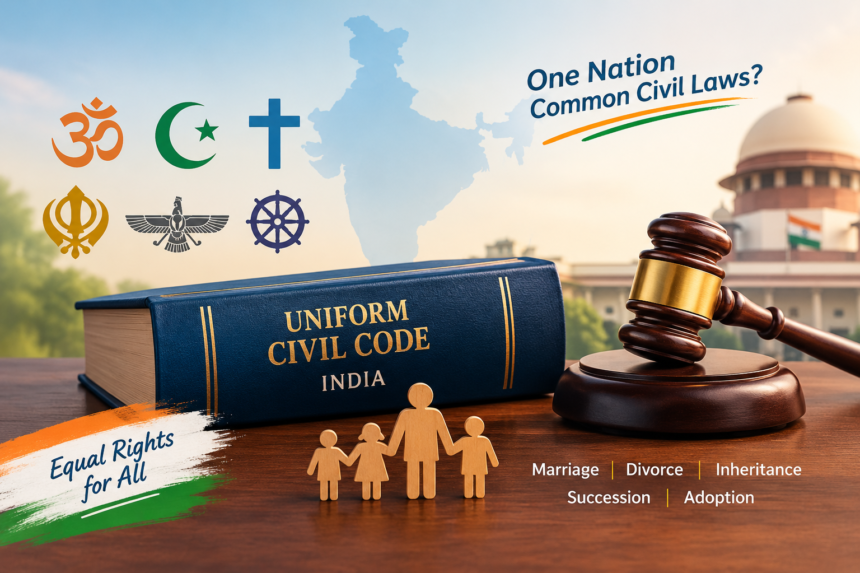
The Uniform Civil Code refers to the idea of having common civil rules governing personal and family matters such as marriage, divorce, inheritance, succession and adoption, irrespective of religion.
What is the Uniform Civil Code?
Article 44 of the Constitution states that “The State shall endeavour to secure for the citizens a uniform civil code throughout the territory of India.” However, Article 44 is part of the Directive Principles of State Policy and does not itself impose a UCC on citizens.
India currently does not have one nationwide UCC. Instead, personal and family matters are governed through a combination of religion-specific personal laws, secular legislation and other laws.
The existing legal framework includes laws such as the Hindu Marriage Act, 1955; Hindu Succession Act, 1956; Indian Christian Marriage Act, 1872; Parsi Marriage and Divorce Act, 1936; Muslim Personal Law (Shariat) Application Act, 1937; and Special Marriage Act, 1954.
Why is UCC being pursued?
Supporters of the UCC argue that common civil rules could establish the same legal standards for citizens in areas such as marriage, divorce, inheritance and adoption.
The proposal is also connected to the constitutional objective contained in Article 44.
At the same time, the issue has generated debate because India’s communities follow diverse religious, cultural and customary practices. Questions have also been raised about the treatment of tribal communities and groups whose customary rights receive constitutional protection.
What could change under a UCC?
The exact changes would depend on the provisions of the particular UCC law enacted by a state or, in the future, at the national level.
Depending on the legislation, a UCC could establish common rules concerning:
Marriage and marriage registration
Divorce
Maintenance
Inheritance and succession
Adoption
Other family-related civil matters
A UCC would primarily concern the legal consequences of family and civil relationships. It would not necessarily mean that religious beliefs or religious ceremonies themselves would be prohibited.
Is UCC already applicable across India?
No. There is currently no single nationwide UCC in force.
Uttarakhand has implemented its own UCC. The state’s official UCC framework covers areas including marriage, divorce, succession, adoption and related matters.
Union Home Minister Amit Shah has now said that the UCC will be implemented in all 21 NDA-ruled states before 2029. However, that remains a stated implementation plan; each state would still need to follow the applicable legislative and administrative process.
What about tribal communities?
This is particularly important when discussing UCC in northeastern states.
The treatment of tribal communities depends on the specific legislation and constitutional protections involved. For example, Uttarakhand’s UCC expressly excludes Scheduled Tribes and certain groups whose customary rights are protected under Part XXI of the Constitution.
Therefore, it would be inaccurate to assume that a UCC adopted in one state will automatically have exactly the same exemptions or provisions in another state.
For Tripura, the precise impact would depend on the legislation, exemptions and rules actually adopted by the state. Political statements alone do not establish what the final legal position would be.
The bigger question
The UCC debate concerns how India approaches common civil standards while accommodating the country’s religious, cultural and customary diversity.
Supporters emphasise common legal rules and uniform standards, while critics and some community representatives have raised concerns about the impact on personal laws, customs and constitutionally protected communities.
As more states consider UCC legislation, the actual text of each law, its exemptions and its implementation rules will determine how marriage, divorce, inheritance and other family-related matters are affected.
For now, the key distinction is clear: UCC is not currently one nationwide law that has replaced India’s existing personal-law system. It is an ongoing legislative and political process, with Uttarakhand providing one state-level model and other states considering their own approaches.