



Agartala, August 27, 2026: Drinking-water supply and the progress of piped-water connections across Tripura came under discussion in the state Assembly on Thursday, with BJP MLA Jahar Chakraborty and TMP MLA Ranjit Debbarma raising concerns over access to safe drinking water in different parts of the state.
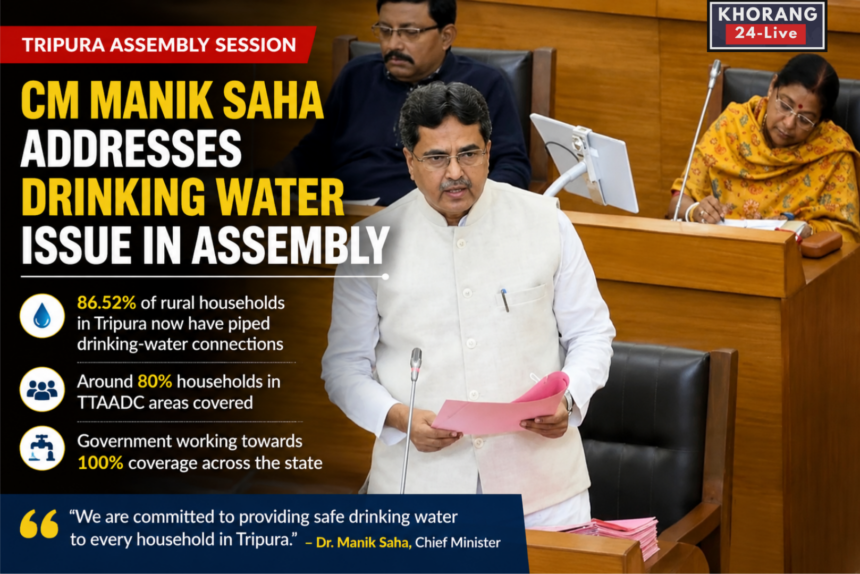
Responding to the questions, Chief Minister Dr. Manik Saha said Tripura has made significant progress in expanding piped drinking-water coverage under the Jal Jeevan Mission, with 86.52 per cent of rural households now connected to piped water.
According to the Chief Minister, as of August 20, 2026, a total of 6,47,437 out of 7,50,449 rural households had received piped drinking-water connections. He said coverage stood at only 3.24 per cent in 2019, when the Jal Jeevan Mission was launched in the state.
Saha said that 1,91,106 rural families have been brought under safe drinking-water coverage over the past three years. Piped-water facilities have also been extended to 1,193 Gram Panchayats and Village Committees across Tripura.
During the discussion, TMP MLA Ranjit Debbarma raised the specific difficulties faced by people living in the Tripura Tribal Areas Autonomous District Council (TTAADC) region. He highlighted drinking-water shortages in remote and hilly areas, particularly in Mungiakami Block, and urged the government to take effective steps to address the problem.
Replying to Debbarma’s supplementary question, Saha said that around 80 per cent of households in the TTAADC region have now been covered by piped drinking-water connections. However, he acknowledged that supplying water to some remote and hilly settlements remains challenging because of the terrain and the limited availability of suitable groundwater sources.
The Chief Minister said the government is exploring alternative solutions for such areas. These include using water from streams, springs, canals and waterfalls, as well as pumping water to higher-altitude settlements where necessary. Deep and shallow tube wells and water-treatment plants are also being considered or utilised depending on local conditions.
Saha said the government remains committed to achieving 100 per cent piped drinking-water coverage across the state and is working to address the remaining gaps, particularly in difficult-to-reach areas.
The Assembly discussion also highlighted the difference between overall state-level coverage and the challenges faced by communities in the hills. While Tripura’s overall rural piped-water coverage has reached 86.52 per cent, the government is continuing efforts to ensure that households in remote areas, including those under the TTAADC, are not left behind.
The questions raised by Jahar Chakraborty and Ranjit Debbarma brought the issue of drinking-water access into focus during the Assembly session, with the government outlining both the progress achieved under the Jal Jeevan Mission and the measures being explored to reach the remaining uncovered households.