



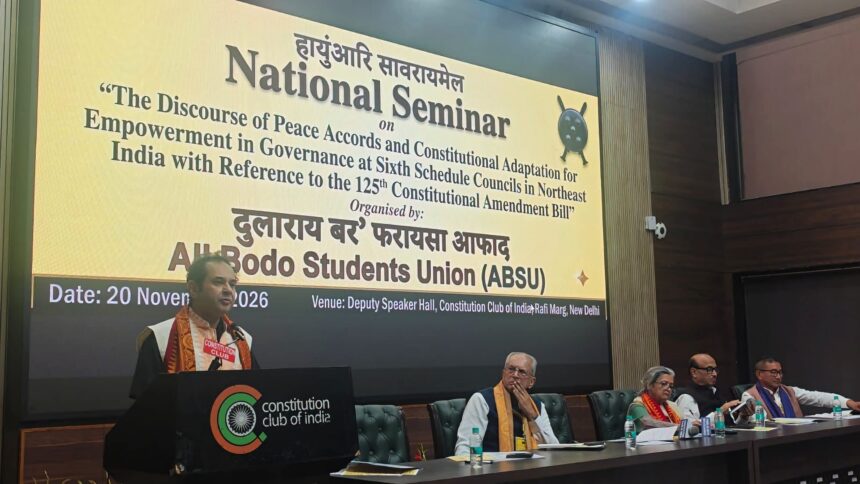
New Delhi, November 20, 2026: Bubagra Pradyot Bikram Manikya Debbarma and MLA Ranjit Debbarma attended a national seminar at the Constitution Club of India in New Delhi on Friday, bringing Tripura’s representation to an important discussion on the empowerment of Sixth Schedule autonomous councils, implementation of peace accords and proposed constitutional reforms in Northeast India.
The seminar was organised by the All Bodo Students Union (ABSU) at the Deputy Speaker Hall of the Constitution Club of India. The central theme was “The Discourse of Peace Accords and Constitutional Adaptation for Empowerment in Governance at Sixth Schedule Councils in Northeast India with Reference to the 125th Constitutional Amendment Bill.”
The programme focused on the implementation of the Bodo Peace Accord, 2020, its achievements, continuing challenges and emerging opportunities. Discussions also centred on the proposed 125th Constitutional Amendment Bill and its potential role in strengthening the governance structure and institutional powers of autonomous councils across the Northeast.
Several prominent personalities from the political, administrative, academic and legal fields participated in the seminar. Among them were former Union Home Secretary G. K. Pillai, former Intelligence Bureau Director A. K. Mishra, Bubagra Pradyot Bikram Manikya Debbarma, MLA Ranjit Debbarma, Professor Ramesh Bhardwaj, senior Supreme Court advocate B. L. Hansaria and prominent journalist Rupa Chinai.
Amarsingh Tisso, Member of Parliament from Diphu, and Khiangte Laltlungkima, Member of Parliament from Mizoram, also attended the programme. Nilakantha Goyary, Secretary of Bodo Sahitya Sabha (BSS), and Manoranjan Basumatary, President of the United Boro People’s Organisation (UBPO), were among the other participants.
A major focus of the seminar was the Constitution (125th Amendment) Bill, 2019, which was introduced in the Rajya Sabha on February 6, 2019. The proposed legislation seeks to introduce changes to the Sixth Schedule and Article 280 of the Constitution, with provisions aimed at strengthening the administrative and financial framework of autonomous councils.
The proposed reforms include provisions relating to elected village and municipal councils, financial arrangements, institutional responsibilities and greater participation in local governance. The Bill has particular relevance for autonomous councils in Assam, Meghalaya, Tripura and Mizoram. However, it remains pending in Parliament and has not yet become law.
The Bodo Peace Accord, signed on January 27, 2020, between the Government of India, the Assam Government and representatives of Bodo organisations, was another central subject of discussion. The agreement was aimed at addressing longstanding political, territorial, cultural and developmental issues concerning the Bodo community, while strengthening peace and stability in the region.
For Tripura, the discussions hold particular significance because the Tripura Tribal Areas Autonomous District Council (TTAADC) functions under the Sixth Schedule of the Constitution. Strengthening the financial, administrative and institutional framework of autonomous councils could have wider implications for tribal self-governance, grassroots democracy and development in the state.
The participation of Bubagra Pradyot Bikram Manikya Debbarma and MLA Ranjit Debbarma highlighted Tripura’s presence at the Northeast-focused deliberations, where issues concerning constitutional safeguards, autonomous governance and the implementation of peace agreements were discussed alongside representatives and experts from different parts of the region.
The seminar provided a platform for political representatives, policymakers, constitutional experts and organisations to exchange perspectives on the future of Sixth Schedule institutions and the need to strengthen governance mechanisms in Northeast India.