


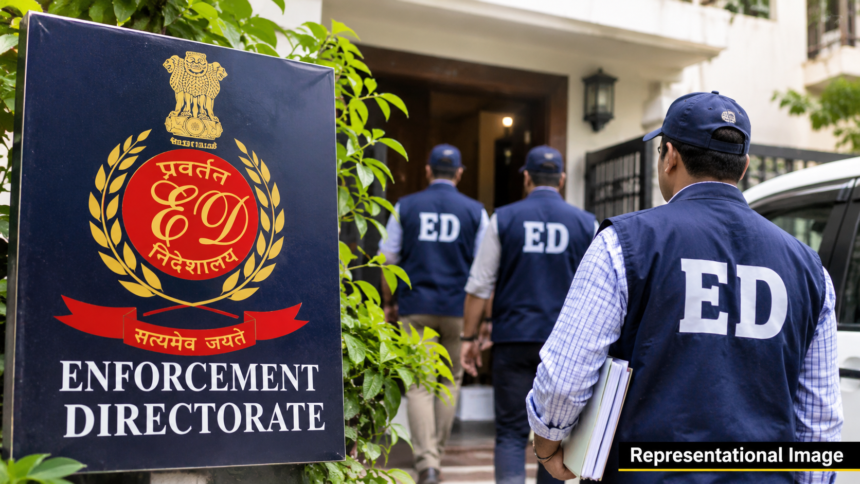
Agartala: The Enforcement Directorate (ED) has conducted search operations at 13 locations across Tripura, West Bengal and Maharashtra in connection with an alleged ₹14.55-crore fake government tender scam involving a fictitious government entity and a suspended Tripura-cadre IAS officer.
The searches were carried out on November 4 by the ED’s Agartala Sub-Zonal Office under Section 17 of the Prevention of Money Laundering Act (PMLA), 2002. The operation reportedly covered the residential premises of suspended IAS officer Abhishek Chandra, along with locations linked to suspected associates, financial intermediaries and companies allegedly connected to the transactions.
According to the investigating agency, the case originated from a complaint filed by Nagpur-based M/s SK Sales Corporation, following which an FIR was registered at Capital Complex Police Station in West Tripura.
The complainant alleged that between September 2024 and February 2025, the company was induced to deposit approximately ₹14.55 crore as Earnest Money Deposits (EMDs) against purported government tenders relating to the Mid-Day Meal scheme and the power sector in Tripura.
However, the ED’s investigation reportedly found that the tenders in question had never actually been issued by the Tripura Government.
Fictitious Directorate of Higher Education Allegedly Used
Investigators suspect that a fictitious entity operating under the name ‘Directorate of Higher Education’ was allegedly used to collect money from the complainant.
According to the ED’s findings, Abhishek Chandra allegedly projected himself as an influential authority in government tender-related matters and introduced the complainant to Utpal Kumar Chowdhury, who was reportedly presented as the person responsible for handling payment procedures.
The agency alleged that the similarly named entity was actually a private proprietorship belonging to Chowdhury and had no connection with the genuine government department.
Investigators further suspect that fabricated tender notices and work orders were circulated to make the transactions appear legitimate. A joint venture involving Krishna Chakraborty, represented by her husband Sudip Paul, was also allegedly used in the collection of funds.
Money Trail and Suspected Hawala Connections
The ED reportedly suspects that the money deposited into the accounts of the fictitious entity was subsequently transferred through multiple shell companies, some of which were allegedly registered in the names of domestic workers and associates.
The agency is also examining suspected investments in high-value properties, including residential properties in Mumbai, reportedly registered in the names of family members of the suspended IAS officer.
Investigators are further examining alleged expenditure on overseas travel and luxury purchases, along with suspected transactions routed through a Kolkata-based hawala operator.
Documents and Electronic Devices Seized
During the latest search operation, ED officials reportedly seized a substantial volume of documents relating to suspected hawala transactions, records of high-value properties, electronic devices and materials indicating possible indirect control over certain corporate entities.
The seized materials are expected to be examined as investigators continue tracing the alleged financial network and identifying the individuals and entities connected to the transactions.
Separate Investigation Into Alleged ₹44-Crore Fraud
The ED is also investigating a separate alleged financial fraud involving multiple victims and losses exceeding ₹44 crore. The case reportedly involves five FIRs registered in Tripura and West Bengal and an allegedly similar modus operandi involving the same fictitious organisation.
The agency had earlier issued provisional attachment orders dated January 22 and July 31, 2026, in connection with that investigation.
The latest searches mark another significant development in the investigation into alleged fraudulent government tender transactions involving Tripura.
Further investigation is underway. The allegations against the individuals concerned remain subject to investigation and judicial proceedings, and guilt has not been established by a court.