



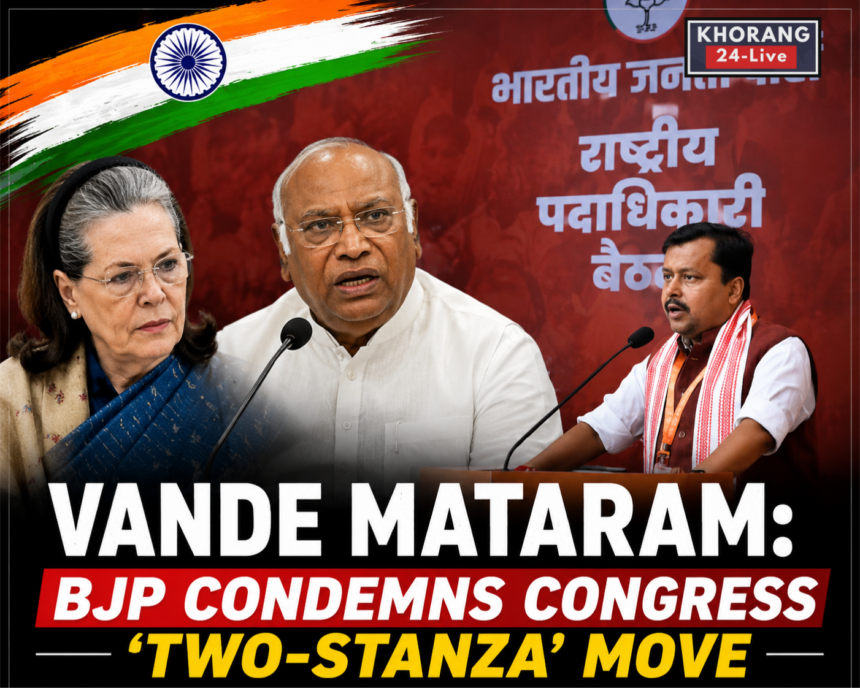
The BJP has strongly criticised the Congress over its reported decision to limit the singing of Vande Mataram to its first two stanzas, calling for respect for the song’s historical role in India’s freedom struggle and national consciousness.
New Delhi, August 22, 2026: The Bharatiya Janata Party (BJP) has launched a strong attack on the Congress over its reported decision to restrict the singing of Vande Mataram to its first two stanzas at party programmes.
In a detailed press release issued on August 22, 2026, the BJP said it strongly opposed the Congress Working Committee’s reported decision of August 19, 2026, to reaffirm the Congress’s 1937 position regarding the singing of Vande Mataram.
The BJP said Vande Mataram represents respect for Bharat Mata, the spirit of India’s freedom struggle and the country’s national consciousness.
BJP highlights Vande Mataram’s role in freedom struggle
The BJP traced the historical journey of Vande Mataram, written by Bankim Chandra Chattopadhyay, and said the song played an important role in creating national awakening during the freedom movement.
According to the BJP, Vande Mataram, which expresses reverence for the motherland, became a powerful slogan during the Swadeshi movement following the Partition of Bengal in 1905
The party also highlighted attempts by the British administration to suppress the song, arguing that restrictions could not prevent it from becoming part of the national movement.
The release referred to restrictions on its public singing in Barisal in 1906 and its appearance on a flag displayed by Madam Bhikaji Cama in Stuttgart in 1907.
BJP questions Congress’s 1937 decision
The BJP said it was a historical contradiction that a song used extensively during the freedom struggle was later restricted because of concerns surrounding some of its religious references.
The party referred to the Congress Working Committee decision of October 28, 1937, under which only the first two stanzas of Vande Mataram were to be sung on national occasions.
The BJP argued that the decision eventually resulted in the remaining portions of the song becoming unfamiliar to later generations.
The press release also referred to the 1923 Kakinada Congress session, where objections were reportedly raised during the singing of Vande Mataram.
BJP cites Gandhi’s views
The BJP also referred to Mahatma Gandhi’s views on Vande Mataram, arguing that Gandhi recognised the song’s importance during the freedom struggle.
The party cited Gandhi’s observation that Vande Mataram had become a powerful bond between Hindus and Muslims during the days of the Bengal Partition.
The BJP said this historical context demonstrated that the significance of the song could not be viewed solely through the religious imagery contained in some of its verses.
References to Rajagopalachari and Patel
The BJP press release also referred to correspondence involving C. Rajagopalachari and Sardar Vallabhbhai Patel in January 1939 in the context of discussions surrounding Vande Mataram.
The party used Rajagopalachari’s reported concerns about political compromises to argue that concessions made under communal pressure could create further political demands in the future.
The BJP said the warning remained relevant in the current political environment.
BJP discusses Jana Gana Mana and Vande Mataram
The BJP also referred to developments surrounding India’s national symbols following Independence.
According to the party, on January 24, 1950, Dr Rajendra Prasad announced that Jana Gana Mana would be accepted as the national anthem, while Vande Mataram, because of its historic role in the freedom struggle, would continue to receive national respect.
The BJP argued that both songs have an important place in India’s national consciousness, although Jana Gana Mana became the principal anthem used at formal state functions.
The party further said that over the decades the first two stanzas of Vande Mataram became the most widely known portion of the song, while later verses became less familiar.
BJP invokes Prevention of Insults to National Honour Act
The BJP also raised the issue of legal protection for national symbols.
The party referred to the Prevention of Insults to National Honour Act and argued that political parties cannot adopt interpretations of national symbols based solely on political considerations.
The BJP maintained that a resolution adopted by a political party cannot override constitutional arrangements or parliamentary legislation.
The party also stressed that Vande Mataram does not belong to any particular political party.
“A national song is not the property of any political party,” the BJP said in its press release, arguing that its respect should not depend on electoral calculations, political convenience or vote-bank considerations.
BJP announces its position
The BJP said it would strongly oppose the Congress decision of August 19, 2026, concerning the singing of Vande Mataram.
The party said the historical significance of the song and its contribution to India’s freedom struggle must be preserved.
It also accused the Congress of returning to what it described as a politics of appeasement and communal considerations.
Political debate likely to intensify
The BJP’s statement is expected to intensify the political debate surrounding Vande Mataram, its historical legacy and its place in public and political programmes.
While the BJP has framed the issue around national pride, historical memory and the freedom struggle, the Congress position is linked to longstanding debates surrounding certain portions of the song and their religious references.
The latest exchange adds another chapter to the wider political debate over national symbols and their interpretation in contemporary India.
For the BJP, the issue is not simply about how many stanzas are sung at party programmes. The party argues that the complete historical legacy of Vande Mataram should be preserved and that the song should remain above political and electoral considerations.